
Changes to the Driving Test
starting 24 November, 2025
For details please see Making adjustments to the driving test.
NEW *** Changes to Driving Test Booking Rules - 2026 ***
Only you, the Learner, will be allowed to book your driving test. Your Driving Instructor, or any Third Party Booking App will not be able to book it for you.
The Driving Test
Driving Test – Purpose?
If you have ever heard people say, “You learn to drive once you pass your test,” you may wonder, “What is the reason for the Driving Test?” This may sound strange, but you do not need to be a “Good Driver” to pass the driving test. To pass the test, you must demonstrate to the examiner that you are a SAFE driver. You can pass the test with up to 15 minor driving faults. It does not have to be a perfect drive; that is not what the examiner is looking for. They are looking to make sure you are a safe driver. If you commit a Serious or Dangerous fault, or your examiner has to take action to keep you safe, you will fail the test. However, if you have 15 or fewer minor driving faults, you have demonstrated you can drive safely, and you will get a Full Driving Licence. Now, once you have your own car and are driving without being supervised, you will gain the experience to enable you to go on and become a good driver. So, it is true: “You learn to drive once you pass your test.” The Driving Test is to make sure that you are safe to be on the roads, on your own.
The Driving Test – An Overview.
The Practical Driving Test is unlike most tests you will ever have to sit. It can be very negative. On a normal exam, you need to give the Correct answers. On the Theory test, you had to give the Correct answers. On the Driving Test, the examiner will record any faults you make. If you only make a few faults, you will pass. If you have too many faults, you will not pass. You do not get marks for good driving, although it does give a good impression of your overall driving standard.
Where
do I take my
Practical Driving Test?
When learning to drive, you do not learn on specific “Test Routes”. Once you can drive, the principles you learn can then be applied in all situations, and you can
drive anywhere. All Test Routes are designed to provide a similar variety of different road and traffic situations. In theory, it shouldn’t matter which Test Centre you apply to for your test; the
Test Routes will be similar and all the examiners test pupils to the same standard. Wherever you choose to sit your test, if you drive to the acceptable standard, you will Pass. In practice though,
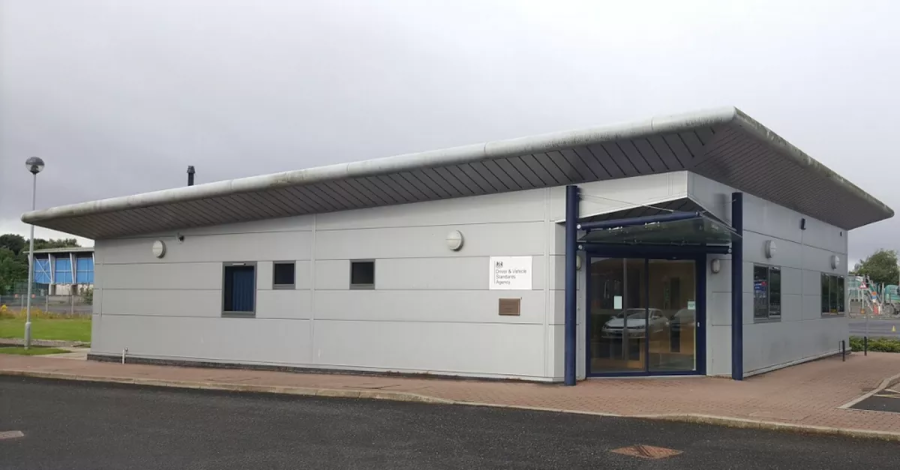
it may be easier if you are familiar with the area. The Test Centres we use are:
Bishopbriggs, Baillieston, Airdrie, Grangemouth and Stirling.
Is there a Driving Test Centre in Cumbernauld?
Not yet. But I am sure there will be one in the future.
How do
I Book my
Practical Driving Test, and how much will it Cost?
You can contact the Practical Driving Test Booking Office in three ways: fill in and post an application form; make a booking over the phone; or
BOOK a TEST
ONLINE.
Booking online is the most common and convenient way for most. You can to see
all the available dates and times at the various test centres and book one that is suitable. By entering your Driving Instructor’s ADI number, this will ensure he has not got another Test booked at
the same time. If booking the test yourself, be sure to confirm that the
time and date is suitable with your instructor and that the car will be available. The
cost of the Practical Driving Test is £62 or £75 for evening or weekend tests. If you are being charged more than £62 or £75, you are looking at the wrong website. Many
3rd Party
websites that will book a test for you, but they will charge a booking fee on top of the normal Test
fee. Make sure you are on the official DVSA website before booking. Best to
let your Instructor book the Driving test for you, so that you can be sure that the Date and Time are suitable. Lesson times can usually be changed to fit in with a test, but make sure your
instructor doesn’t have another
test at the same time.
When should I Book a Driving Test?
Because of the current waiting times for tests, it is usually a good idea to book your Driving Test as soon as you can, i.e. after you Pass the Theory Test. However, always follow your instructor’s advice as to when you are ready to sit the test. There is no advantage in sitting the test if you are not ready - you will fail. Your instructor will not allow you to sit the test in his car if he feels you are not ready. The cost of a Practical Driving Test is £62 (£75 for evenings and weekends, if evening or weekend tests are available). In addition, there will be the cost of (at least) a two-hour driving lesson if you use the Driving School car. Two hours will cover the time taken to get to the Test Centre and back, and the duration of the test. The majority of pupils book an extra hour to allow enough time for a lesson or practice before the test, in the test area.
What can I do if I can’t get the Test Date I Want?
There is quite a long waiting time to get a Driving Test Date. If you can’t get the date you would like, book one that is available. That will give you a date to work towards. If you are ready for a test earlier than your Test Date, we will try to get a Cancellation. Check the website every day or as often as you can. If someone cancels a test, it will become available, so the more often you check, the more chance you have of securing a new date.
What do I need to take to the Driving Test?
-
Your Driving Licence. No Licence, no test. Double-check you have it before you leave for the test centre.
-
You must have a car. This can be your Driving Instructor’s car or your own car. You do not need a car with Dual Controls, but your car must be Insured, have “L Plates” and a Rear View Mirror for the examiner. For more details, see “Using your own car for your test.”
-
It is also useful to have a copy of the Test Booking email with the Test Centre, Date and Time of the test.
What
does the Practical Driving Test Involve?
Try to arrive at the Test Centre a few minutes before your test time. This
will help you relax and not feel under pressure if you are rushing or have the anxiety of being late. There
will probably be a few candidates waiting for a test at the same time. When the examiner calls your name,
make yourself known to him or her.
The examiner will check your Licence and confirm your name, and that the address on your licence is still current. He will ask for a signature to confirm that 1. The car is insured for you to drive, and 2. You are a resident in the UK. After you sign the form, he will compare the signature with the one on your licences as a further identity check. You will be asked to confirm your email address and this is where the Test Results will be emailed to. You will be asked if you want your instructor, or supervising driver, to accompany you on the test. If so, it will be as an observer only, and they will take no part in the test. You will be asked to lead the way out to the car, and once outside, they will check your eyesight.
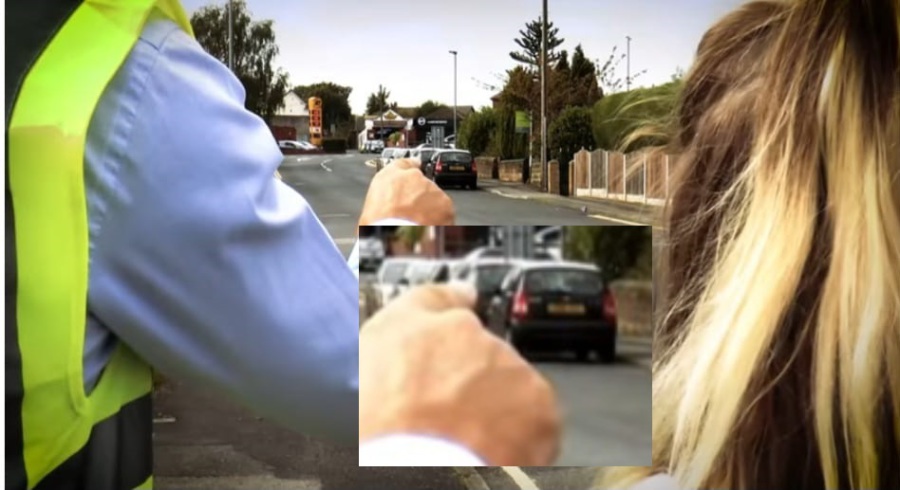
You will then be asked a question on vehicle safety: a “Tell Me” question. (You will be asked the “Show Me” question later when you are driving.) The examiner will walk around the car, for a brief, visual check, noting the registration number, your instructor’s badge number and whether the car is fitted with Dual Controls. The examiner will offer to explain a bit about the format of the test. He will probably say something like: “We will be out on the road for about 35 – 38 minutes. During that time, we will be on a variety of roads with different speed limits. What I would like you to do is: Follow the road ahead at all times, unless road signs or markings tell you differently. When I want you to turn, I will give you directions in plenty of time. If at any time you are unsure of the directions, please ask me, and I will repeat or clarify them for you. I will ask you to drive independently, to carry out one of the manoeuvres you have been practising, and possibly an emergency stop." He will ask if you have any questions?” If you do not, you will be asked to “Drive on when you are ready.”
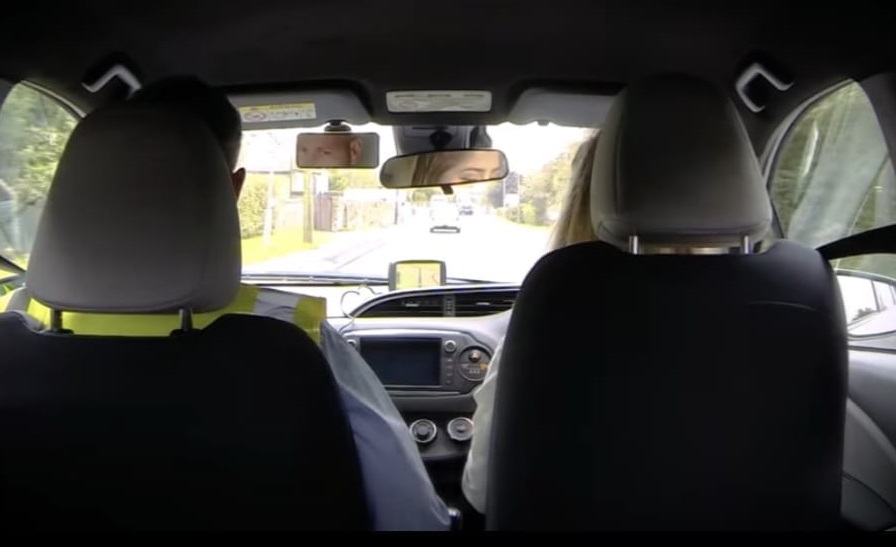
You will then you will be directed around a test route consisting of various road and traffic situations. The direction will be vocal, or using a SatNav or following Road Signs to a given destination for the independent driving section of the test. If you are required to do an Emergency Stop, you will be given specific directions nearer the time. On average, only one in three tests includes an Emergency Stop (or a Controlled stop, as the examiners call it). The examiner will spend much of the test looking at you. This is to satisfy himself that you are taking proper observations. The examiners are all very friendly, but do not be surprised if they do not talk during the test. They do not want to distract you, but do not take their silence as disapproval. When you arrive back at the Test Centre, you will be told whether you have Passed or not. You will Pass your Test if you commit 15 or fewer Driving Faults and have done nothing Serious or Dangerous. If you commit an accumulation of the same Driving Fault or a Serious or Dangerous fault, you will Fail. If the examiner has had it intervene to keep you safe, either verbally or physically, that will result in a fail. After the Test, the examiner will offer an explanation of the result in a debrief. You may ask your instructor to be present to hear the debrief. The total duration of the Test is about 40 minutes.
What
are the most Common Reasons
for Failing
the Driving
Test?
You do not need to be a great driver to pass your driving test - but you must be a safe driver. The
examiners are not looking for a perfect drive. If he/she can see you demonstrate that you are safe on the road, you will get your licence. You can then go on and become a great driver. However,
it is a high standard they look for in the driving test. Most people fail their test because they are not safe to be out on the roads on their own. Mostly, it is not the technical
skills that are lacking, but poor
observations. For
example, you could be inch-perfect reversing into a
Parking Bay, yet
if you fail to look the way you are going, or are not aware of what is going on around you, you will fail for
poor observations. The top
3 reasons for Test Fails are Poor
Observations. For more details, please see Top
10 Reasons for Failing the Driving Test in Great Britain
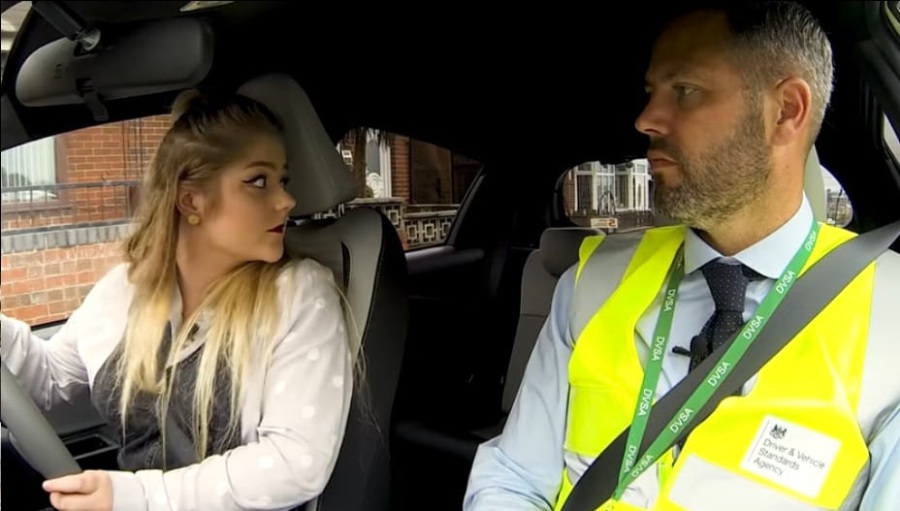
Concentration is also important throughout the test. You must be aware of what you are doing and what is happening around you; and you must concentrate throughout the whole test. One lapse could result in a Serious or Dangerous fault. Imagine this situation: You recognise the road and you know the test is nearly over; you feel you have driven well and you can’t wait to get on the phone and tell your friends the good news; “we can go out and celebrate,” “I am going to buy a car”… and the concentration goes. It is amazing how many serious faults occur during the last half-mile back to the Test Centre. Do not relax until the car is stopped, the handbrakeis on, gear to neutral, switch engine off. After the Examiner gives you the good news, then you can start phoning and think about celebrating and buying a car.
What if I have moved house recently and the
Address on my Licence is no longer Valid?
It is a legal requirement that you keep the DVLA informed of any changes to personal details, like a new name or address or health issues. However, the driving examiners
appreciate that you do not want to send your licence away a few days or weeks before a test, in case you don’t get it back in time. Normally, when you pass the test, your new, full driving licence
will be posted to the address on your licence. If your address is not current, it just means you will have to apply for the new licence yourself,
and, at the same time, inform the DVLA of your new address. Warning -
Remember to apply for your new licence within 2 years, or you will need to sit both tests again.
Is there any advantage to having my Instructor sit in on my Test?
This is a personal decision; you must decide what is best for you. It is your test; you must give yourself the best chance of passing it. But here are
some things to consider: If you are very nervous about the
test, it may be helpful and calming to have someone you know sit in with you to try to help you relax. However,
if you are very nervous about the test, you may feel extra pressure having two people watching your driving, instead
of just one. If you fail your test, if your
instructor is with you, he will see
exactly what happened and will be able to explain it to you and work with you to prepare for the next test. However, if you fail your test, the examiner will give both you and your instructor a
details account of what the fault was in the debrief at the end. This
will allow you and your instructor to work on the fault
and prepare you for the next test. Sometimes, during a lesson, I
will talk about tests I have sat in on. This might give the impression that I sit in on a lot of tests, but this is not the case. I only talk about
the tests that I sit in on,
as I have no first-hand knowledge of the majority of tests that I do not go on. If you decide to go on your own for the test, don’t worry about me: I will not be standing on the
pavement, in the rain, waiting for
you to return. I will be in the office, with a coffee and chatting to
the other instructors who also have pupils
out on test. The point is: it is a personal choice: make up your own mind about what will be best for you. Talk to your instructor about it, or maybe you have a friend who has sat a test recently;
what worked for them. It is your test; you must give yourself the best chance of passing
it. Your instructor will be happy to accompany you if that is your choice, but he will not be offended if you want to go
out on your own.
I have heard the examiners have Quotas and can only pass a certain number each day. Is that true?
NO! That is a rumour that has been doing the rounds for many years, but there is no truth in it. It can be a very demoralising time if you fail a test. It might soften the blow if you can say to yourself, “I drove well, but he had to fail me.” If you drive to the required standard, you will pass the test, even if every other candidate has already passed that day. There are no quotas. If the examiner fails you, you will be given a comprehensive debrief and a marking sheet clearly showing the fault/s committed.
Will I Fail if I get one of the “Show Me / Tell Me” Questions Wrong?
If you get one of the questions wrong, it will be recorded on the marking sheet as “1 x Driving Fault”. If you get both questions wrong, it will still be “1 x Driving Fault.” Getting a question wrong is unlikely to affect the outcome of your test. It is unlikely that you will get 15 Driving Faults on the road, and the fault for the wrong Show Me / Tell Me question, is the one that will put you over the limit for a fail. That would be more of an indication of poor driving. The real danger of getting a question wrong is: it might distract you from your driving. At the start of the test, as you come up to the first junction, instead of concentrating on the junction, you might still be thinking, “What was the correct answer? Was it 1.6 millimetres of tread…?” Lack of concentration might lead to a poor decision and a serious fault. Best to be familiar with all the questions so that you will be able to answer correctly, and forget about the questions. If you do happen to get one wrong, forget about the question and concentrate on your driving.
My instructor says I am not ready for a test, but I think I will “give it a go” for the experience.
Definitely not! Our Terms & Conditions clearly state:
Use of the vehicle. In the interests of customer and public safety, I reserve the right to withhold the use of the training car for the test if, in my opinion, your driving is actually or potentially dangerous - behaviour which if repeated on the test, would result in a test failure.
You must demonstrate that you can drive to the Driving Test Standard before you take the test. Knowing how to drive is not enough; this is a practical test. You must demonstrate that you can drive to the required standard. As part of the training, we will have “Mock Tests.” This will give you the chance to experience what the driving test is like, but it will also let us both see the standard of your driving. If you are not passing the Mock Tests consistently, it is unlikely that you will Pass the real Test. Any professional driving instructor will not allow you to go for a test if you are not ready, as you are putting yourself, the driving examiner and other road users in danger. At the start of the test, the examiner will note your Instructor’s ADI Badge number on the marking sheet. If the test goes badly and there are numerous driving, serious or dangerous faults, it will call into question the standard of the training you are receiving. This will result in your instructor being called for a “Standards Check” test to make sure he is doing his job properly. It can be a common thing for candidates to Fail a test, but the Driving Examiners can tell the difference between someone who is a bit nervous and made a mistake on the test, and someone who is clearly not ready to drive and should not be taking their test. A Driving Instructor cannot prevent you from sitting your test, but he will not allow you to use his car, thus giving the impression that he is happy with the standard of your driving. You may, of course, attend the test with your own car, but you would be advised to follow the guidance of your instructor.
What if I need to put my Test Date Back to give me More Time to Prepare?
As long as you change your Driving Test with at least 10 working days' notice, you will not lose your fee. If it is cancelled with the same 10 working days' notice, you will receive a refund. Log on the DVSA website CHANGE YOUR DRIVING TEST APPOINTMENT and search for a new date. If you can’t get the date you would like, book one that is available. Check the website every day or as often as you can. Every week new test dates are released and become available. If someone cancels a test, it will become available, so the more often you check, the more chance you have of securing a new date.
Are there any software programs that can help me prepare for the Practical
Driving Test?
Particularly recommended is LDC’s PC DVD-ROM “DRIVING
TEST COMPLETE.”
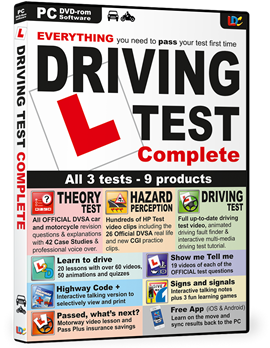
As well as containing everything you need to Pass your Theory & Hazard Perception Test, this DVD also has much information about the practical Test. Modules 3-7 are:
LEARN TO DRIVE:- 20 lessons with over 60 animations, videos & quizzes.
SHOW ME / TELL ME:- Interactive “Drag & Drop” animation & 19 video clips of each of the Test Show me / Tell Me questions.
PRACTICAL DRIVING Test:- Driving Test Video Tutorial; Interactive version of the Test Report marking sheet; animated driving fault-finder and correction; interactive multi-media driving test
tutorial.
HIGHWAY CODE:- Interactive talking version of the Highway Code to selectively view or
print.
SIGNS & SIGNALS:- Correctly recognising Signs & Signals is a key to becoming a safe driver. These interactive notes and fun Learning games will help you fix these signs and their meaning
firmly in mind.
PASSED – WHAT’S NEXT? Video introduction to Pass Plus; Motorway Driving Lesson; 2young2die presentation from the road safety charity “Brake.”
What if
I Fail my Driving
Test?
If you are unsuccessful, the Driving Examiner will tell you immediately the test
finishes. He/she will offer to explain to you the reasons for his decision. Although it is disappointing news, and not the result you were hoping for, it is good to listen to the debrief. It is good
to involver your instructor in the debrief, then together you can make plans correct the faults and pass the test
next
time.
You can book another driving test right away, but you cannot sit another test until 10
working days have elapsed from the last test. This will give you time for more practice and to work specifically on the fault that caused the
fail.
What will happen when I Pass my Test?
Congratulations! You have achieved your goal and now have a Full Driving Licence. The examiner will tell you the good news immediately the test ends. He will ask for your Driving Licence again. If you wish, the examiner will keep your Provisional Licence and arrange for your new, Full Driving Licence to to posted to you. (As long as the address on your Provisional Licence is current, otherwise you will need to apply for the new Licence yourself.) He will write out a PASS CERTIFICATE for you to keep. This will have your Driving Licence details and can be used, if needed, until your new Licence arrives. Please allow 21 days for you new licence to arrive, but in practice it can be much quicker. You are now a Full Licence Holder. You do not need to wait for your new licence to arrive before you can drive, but you must arrange Insurance cover. If you were insured previously as a learner, you must inform your insurance company of your new status as a Full Licence holder. This will probably result in more expensive insurance premiums, as you will now be driving unaccompanied. Although it was a Pass, your examiner will probably offer you a debrief on the drive, including suggestions for your future development. Passing the Driving Test is only the start of a new chapter; you still have much to learn.
Is there anything I can do to Improve my Driving after Passing the Test?
Consider taking the PASS PLUS driving course. Or one of the Advanced Driving Courses like IAM (Institute of Advanced Motorists) or RoSPA (Royal Society for the Prevention of Accidents).
Watch to DVSA Driving Test Video
 Print
Print 